
A Life in the Arts; interview with Nancy Davidson
by Jan Pieter van Voorst van Beest
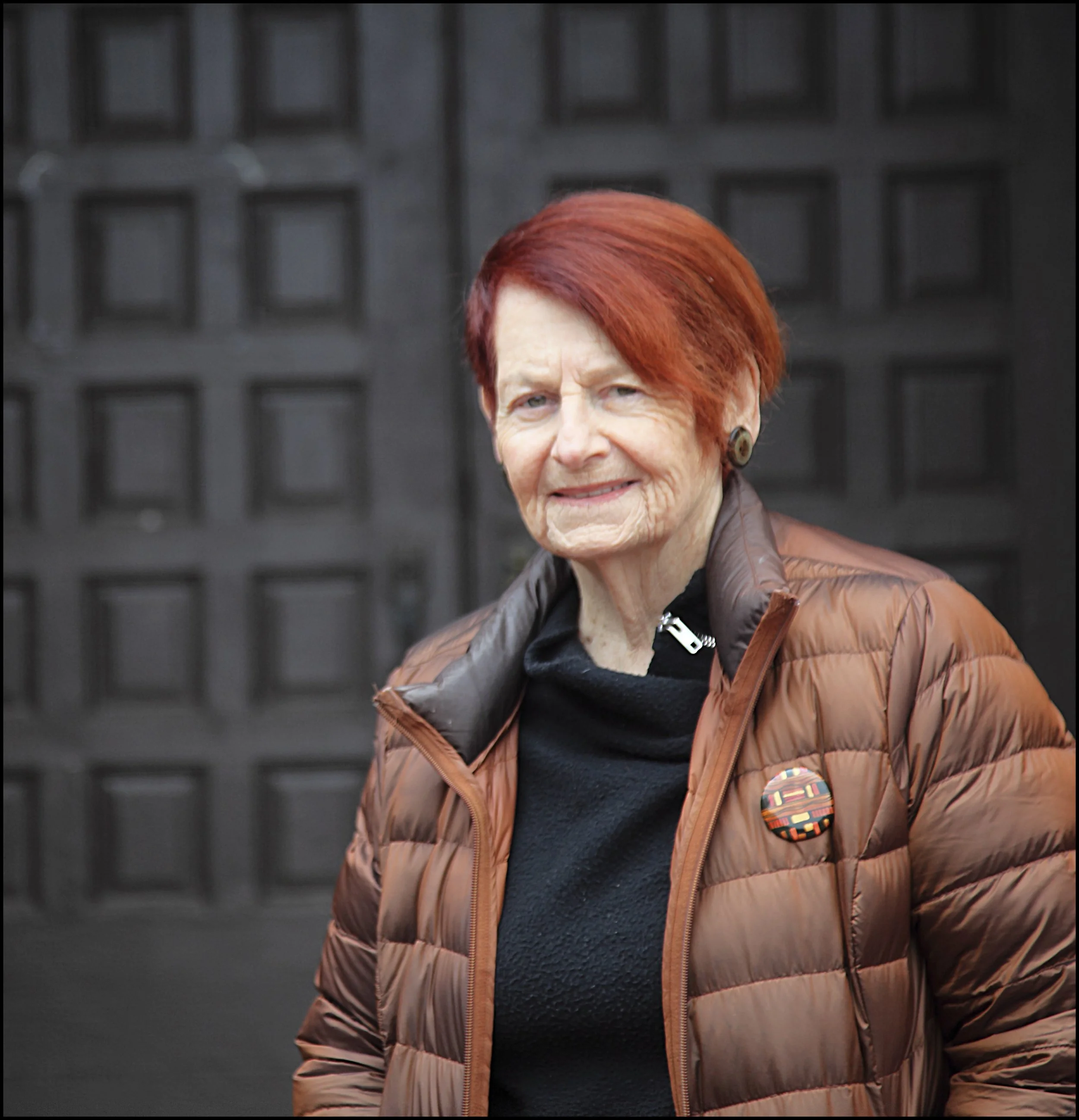
Nancy Davidson’s portrait by Jan Pieter van Voorst van Beest
Jan Pieter: After a long life in the arts and having just retired from your position at the Maine Jewish Museum, what is next?
Nancy: When I retired from the Maine Jewish Museum after eleven and a half years, I knew I would do more Critter Exhibitions. Critters: Fins, Feathers, and Furs which is my 9th Critter Exhibition, is held at Cove Street Arts. The 10th Critter Exhibit will be held at the George Marshall Store Gallery, York, Maine, in 2026 summer-July-August. These shows are fun for the entire family and add joy to many collectors. Also, I am recycling my photograph collection, plus my collection of one-of-a-kind art pieces by many well-known artists. These are some of the artists to be sold: Davis Driskel, Harold Garde, Henry Isaacs, Barbra Sullivan, Rebecca Goodale, Ann Ireland Dorothy Schwartz, Ted Arnold, Lin Lisberger, Abby Shahn, Natasha Mayers, Anita Clearfield, Rush Brown, Oliver Solmitz, Sara Crisp, Ellen Golden, Paul Heroux, and many there are more.
Jan Pieter: How did it all start and who were the important art influencers in your career?
Nancy: My father sold Longines’ watches. The company sent him, over the years, signed limited edition prints as holiday presents. Coincidentally, they were by NY Jewish artists from the 60s; Ben Shahn, Leonard Baskin, and Chaim Gross. Ultimately, they were given to me and they became the beginning of my art collection.
As a child, I went away to summer camp at ten years old . Martin Dibner, the first paid California Arts Commissioner, writer, painter, and a friend of my father’s, visited me there. He said, “ I am going to teach you how to see and look at art.” This was the beginning of a long friendship. When I was in high school, my cousin Bernard “Barney” Osher was beginning to collect art after majoring in Art History at Bowdoin College. He would often let me tag along. When he purchased one-of-kind paintings, I would buy a signed, limited edition print by the same artist. Barney recently exhibited his collection at the San Francisco Museum of Fine Art.
I must share that I went to a private school from kindergarten to 12th grade. We had art classes three times a week. When I graduated, we had ten students in the class. Interestingly, three became professional artist, and I became a gallerist and curator.
I should also mention being the first chairperson of the long running Temple Beth El Art Exhibition for nine years. This introduced and exposed me to many accomplished contemporary artists.
My first purchase of art was a Ben Shahn hand-painted lithograph. I bought it for $90 dollars; $45.00 donated by dad and $45,00 contributed by my husband. I was pregnant with my first child at the time. They were in shock many years later when I sold it along with many others, and paid for half of my children’s education at a private school!
Jan Pieter: Who are some of the most interesting artists you have collaborated with in your life?
Nancy: Some of the most interesting artists have been: Ben Shahn, Louise Nevelson, Bernerd Langlais, Dahlov Ipcar, Henry Isaacs, Harold Garde, Deborah Klotz, Marjorie Moore, David Driskell, Rebecca Goodale, Ted Arnold, Joe Hemes, Juliet Karelson. There are so many more to name, like the Israeli artist, Ruth Bloch. You know, 76 years is a long time to make connections!
Jan Pieter: During part of your career as a gallerist you were in Florida. How different is the art scene between Maine and Florida?
Nancy: Collectors in Florida are moving from winter environments. They tend to buy new condos and houses that are their second or third homes. When it comes to art, they start from scratch. Sometimes they say, “Bring over those nine pieces of art,” and they end up purchasing six of them! I remember a couple from Canada who purchased $87,000 dollars worth of sculpture by an Israeli artist at one time.
In Maine, the average purchase is often piecemeal - one at the time, and there are fewer collectors with the exception of the summer months. Out of state visitors will often purchase many “memories of Maine” in one season. For example, a lady from New York came into the Portland gallery where I am temporarily working. She purchased two paintings and is asking to see additional works which can only be found at the artist studio.
Jan Pieter: Tell us about the how you started to organize the “Critter” exhibits and what do they mean to you?
Nancy: The idea of the critters exhibitions was inspired by Tim Porter who owned the Migis Lodge hotel and gift shop in South Casco, Maine. I saw how his animal pieces brought a lot of joy and many smiles to people’s faces, and they SOLD! Sometimes people forget that selling art and fine crafts is the way galleries and museums stay open. Of course the art is there for your education and entertainment too.
Jan Pieter: In your experience, What do you feel are the complications you get into when you run a contemporary art museum that is sponsored by a religious institution like a synagogue?
Nancy: The bottom line is that the Maine Jewish Museum presents exhibitions by Jewish artists and artists married to Jewish spouses. Sometimes, there is confusion about what makes someone Jewish. This is when the Rabbi is consulted, and it helps if s/he is like a piece of cooked spaghetti - flexible. There can also be a lot of judgement when people do not like or understand abstraction in art.
Jan Pieter: At the Maine Museum of Photographic Arts we will be handling some pieces of your photographic collection in our secondary market/store. As a person who has been in the arts and has exhibited all sorts of mediums, what is your interest in photography?
Nancy: At first, I did not value photography as fine art. Many photographers did not number their photographs or sign them. I felt this devalued the works. There was no way to tell how many prints of a specific photograph were printed. Now, photographs are printed in limited editions and are presented in a much more professional manner. Also, it is important to understand how the techniques used in the printing process adds value. A lot has changed during my lengthy career.